
A new participant called us last month. She’d been on the NDIS for
two years. Her plan included 6 hours per week of “domestic assistance”
but she didn’t know what that actually covered. She thought it was for
general help around the house. Her support coordinator had told her it
included gardening. The provider she’d been using was charging her for
“assisting with shopping” but she’d actually been doing the shopping
herself while the worker waited at the car.
When we sat down with her plan and walked through what NDIS domestic
assistance is genuinely funded to deliver, it turned out she’d been
underusing her hours and overpaying for what she did get. We changed her
roster. Same hours, real domestic assistance, no shopping-from-the-car
charges. Plan budget went 30% further.
This guide is for NDIS participants and family members trying to work
out what NDIS domestic assistance actually covers, what it doesn’t, and
how to make sure your plan dollars are going to real support rather than
provider invoicing inflation. We’re SADC, a registered NDIS provider
based in Riverwood and supporting participants across Sydney. We’ve been
delivering NDIS domestic assistance since 2019.
What Is NDIS Domestic
Assistance?
NDIS domestic assistance is funding under the Core Supports,
Assistance with Daily Life category that pays a support worker to help
with household tasks the participant can’t safely or comfortably do
themselves because of their disability.
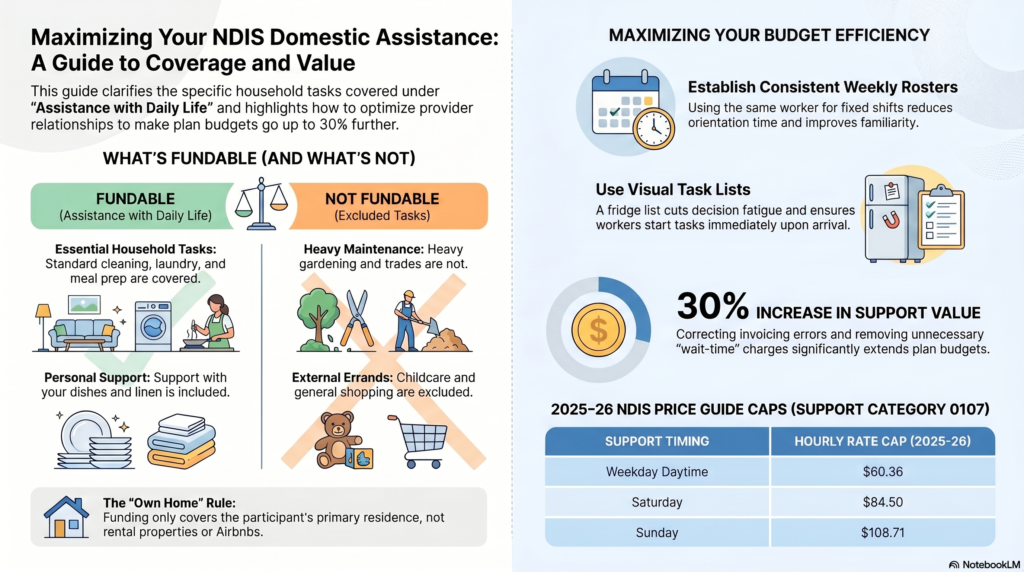
The NDIS Pricing Arrangements 2025–26 list it under support category
0107: Household Tasks. Specifically, the line items
include:
- Cleaning (kitchens, bathrooms, floors, surfaces)
- Laundry (washing, drying, folding, ironing)
- Meal preparation (cooking, packing meals, freezer prep for the
week) - Linen changes (bed making, sheet washing)
- Light gardening (only where part of an approved plan, not always
included)
The standard 2025–26 weekday rate sits around $60.36 per
hour for a single worker. Saturday loaded rates are around
$84.50, Sunday around $108.71, and public holidays higher. Evening
loaded rates apply after 8 pm. Your plan budget is invoiced against
these published price-cap rates, providers can’t legally charge above
them for registered services.
NDIS
Domestic Assistance vs Aged Care Home Help: Critical Difference
This is where new participants get confused, especially older
participants who entered the NDIS before age 65.
Aged care domestic assistance is funded under the
Commonwealth Home Support Programme (CHSP) or Home Care Packages (HCP).
It’s coordinated through My Aged Care, has different eligibility rules,
and the participant pays a means-tested co-contribution. It’s designed
for people 65+ (50+ for Aboriginal and Torres Strait Islander people)
experiencing reduced functional capacity because of age, not because of
permanent disability.
NDIS domestic assistance is funded under the
National Disability Insurance Scheme. It’s coordinated through your NDIS
plan, has no means-tested co-contribution (the NDIS pays the full
provider rate up to your budget), and is designed for people with
permanent and significant disability under 65 at the time of plan
entry.
If you’re on the NDIS, you can’t double-dip into aged care funding
for the same services. If you’re on aged care, you can’t use NDIS
domestic assistance. There are some unusual cases where a participant
has both. For instance, an older person with a long-standing NDIS plan
who has also been allocated a Home Care Package later in life. The
providers and the funding streams stay separate.
The reason this matters: a “domestic assistance” provider who serves
both aged care and NDIS clients isn’t doing anything wrong, but they
often invoice and roster differently between the two. Make sure your
provider knows which funding stream is paying for your shifts. We’ve
seen NDIS participants charged aged care rates (lower) and end up with
reduced service. The opposite happens too.
What Gets
Funded Under NDIS Domestic Assistance?
Specifically, the following tasks ARE generally fundable when they
relate to your disability:
- Cleaning the rooms you use. Bathroom, kitchen,
bedroom, living room. Vacuum, mop, surface cleaning, bathroom scrubbing,
kitchen wipe-downs. - Laundry. Washing, drying, hanging, folding, putting
away. Ironing if needed. - Meal preparation. Cooking individual meals, batch
cooking for the freezer, packing lunches, basic food prep. - Linen and bedding. Changing sheets, washing them,
remaking the bed. - Dishes. Washing up, dishwasher loading and
unloading. - Rubbish. Taking bins out, bringing them back in,
sorting recycling. - Pet care assistance: only if the pet is genuinely
supporting your disability (assistance animal) or if pet-related tasks
are part of your daily living capacity. Routine pet care for a regular
pet usually isn’t fundable.
What’s NOT
Funded Under NDIS Domestic Assistance
This is where participants get caught out. The following are
generally NOT fundable:
- Heavy gardening or landscaping. Mowing, weeding,
hedge trimming, garden bed work. Usually no, unless your plan
specifically lists it (rare). - Major cleaning projects. End-of-lease cleans,
post-renovation cleans, deep carpet cleaning that’s not part of regular
maintenance. These are usually classed as “spring cleaning” and aren’t
standard domestic assistance. - Window cleaning (external). Internal yes. External
usually no. - Shopping for general household goods. Helping you
shop with you present is community access, not domestic assistance.
Doing your shopping for you is sometimes fundable but it has to be in
your plan and there are limits. - Errands not related to the household. Picking up
dry cleaning, returning library books, running to the post office. - Childcare or supervising children. Even if the
participant is the parent, support workers can’t be effectively
babysitting. - Anything requiring a licensed tradesperson.
Plumbing, electrical work, gas fitting, roofing, out of scope. - Pet walking for routine pets. Unless the pet is an
assistance animal and the walking is part of your daily living capacity
needs.
How to Use
Your NDIS Domestic Assistance Hours Well
Here’s what we tell new participants:
1. Plan a weekly schedule, not a wishlist. A
consistent weekly roster of 2–3 hour shifts with the same support worker
delivers far more than a fragmented “whenever I need it” approach.
Knowing the support worker, knowing what they’ll do, knowing the day.
It lets you plan the rest of your week around it.
2. Match the worker to the work. A worker who’s
great at meal prep may not be the right fit for heavy bathroom cleaning.
A worker comfortable with laundry may dislike cooking. Most providers
can match by preference if you ask. We do.
3. Keep a list visible. A short list on the fridge
of “this week, please do these things” cuts decision fatigue for you and
saves the worker from asking. We see plans go further when participants
prep this list ahead of the shift.
4. Don’t worry about workers moving between rooms.
Some participants get nervous about asking workers to start one task
while finishing another. Don’t. The worker can move room-to-room. It’s
normal. Tasks compound.
5. Watch for invoicing discrepancies. Every
NDIS-registered provider must give you (or your plan manager) an
itemised invoice that shows the date, hours worked, support category,
and rate. Check them. If something looks off, ask. Reputable providers
fix invoice errors without complaint. The ones that argue or stall are
signaling they don’t want scrutiny.
What This Costs at SADC
We invoice the published 2025–26 NDIS price guide rates. We don’t
apply hidden surcharges, we don’t charge for cancellation under 24
hours’ notice except in genuine no-shows, and we don’t bundle services
in ways that obscure what you’re paying for.
Practical example for a Bankstown or Riverwood participant:
- 6 hours/week NDIS domestic assistance, weekday daytime, 1:1
worker - Hourly rate: $60.36
- Weekly cost: $362.16
- Annual cost (52 weeks): $18,832.32
That comes from the participant’s Core Supports, Assistance with
Daily Life budget. If your plan has $25,000 allocated to that category,
you’ve got room for the 6 hours/week plus additional one-off shifts as
needed.
A Real Example
Participant: 52-year-old woman with multiple
sclerosis (MS), based in Padstow Plan: Plan-managed,
$34,000 Core Supports, Assistance with Daily Life Support
requested: 8 hours/week NDIS domestic assistance + 4 hours/week
community access
Initial roster (when she came to us): Two 4-hour
shifts on Tuesday and Friday with two different workers. Both workers
spent the first 30 minutes asking what to do.
What we changed: Same total hours, but split into
three 2.5-hour shifts (Monday, Wednesday, Friday) with the same single
worker. Standing list of tasks. Worker arrives knowing what’s happening
that day. Participant doesn’t have to brief at the start of each
shift.
Outcome at 6 months: Participant reported a
meaningful reduction in fatigue around housework. The worker had built
familiarity with the participant’s routine and could anticipate things
(e.g., extra bedding wash on the days the participant had had a
difficult night). Same plan budget, more usable support.
This is what good NDIS domestic assistance looks like in practice:
same hours, same money, materially different result.
How to Start
NDIS Domestic Assistance with SADC
If you’re an NDIS participant looking for domestic assistance support
in Sydney, the steps are:
- Initial enquiry: call our Riverwood office or use
the contact form. Tell us your plan management type (plan-managed,
self-managed, NDIA-managed), your suburb, and how many hours you’re
considering. - Pre-assessment chat: about 30 minutes. We talk
through your plan budget, your specific needs, and whether we’re the
right fit. - Service agreement: drafted based on your plan and
the hours requested. You take it away to review. - Worker meeting: you meet your primary support
worker before any rostered shifts. If the chemistry isn’t right, we
swap. - Rostered support: usually starts 7–10 business
days from signed agreement.
There’s no obligation. If we’re not the right provider, you take your
plan elsewhere. No fee, no awkward follow-up.
FAQ
Can
I use NDIS funding to clean an Airbnb or rental property I own?
No. NDIS domestic assistance covers the participant’s own home where
they live.
Does
NDIS domestic assistance include yard work or gardening?
Light gardening only if specifically listed in your plan. Most plans
don’t include it. Heavy garden work (lawn mowing, hedge trimming) is
generally not fundable.
Can
my partner or family member be paid as my NDIS domestic assistance
worker?
Generally no. NDIS rules limit family members from being paid support
workers in most circumstances, with narrow exceptions for self-managed
participants in remote areas or with specific cultural needs. Talk to
your plan manager.
How often can I
have NDIS domestic assistance?
Whatever your plan budget supports. Most participants we work with
use 2–10 hours per week.
What
if my support worker damages something during a shift?
Registered providers carry public liability insurance. We carry $20
million. If a worker accidentally breaks something, file a report with
us within 7 days and we’ll process it through insurance.
Can I change
support workers if it’s not working?
Yes. We don’t penalise switches. The fit between participant and
worker matters more than scheduling convenience.
What’s
the difference between NDIS domestic assistance and assistance with
daily life?
Domestic assistance focuses on household tasks (cleaning, laundry,
meal prep). Assistance with daily life covers personal care (showering,
dressing, medication prompting). Many participants need both, and the
support categories overlap in plans.
This guide reflects SADC’s current service offering and the NDIS
Pricing Arrangements 2025–26 as of April 2026. Refer to the NDIA website
for the authoritative price guide and rules. For advice specific to your
plan and circumstances, contact us via the form on this site or speak to
your support coordinator.