We’ve been supporting NDIS participants in Bankstown out of our
Riverwood head office since 2019. The drive is twelve minutes on a good
morning. Most of our Bankstown clients we’ve now supported for three
years or more. The same support workers turn up at the same houses, week
in week out, and that consistency is what makes the work actually
work.
This page is for participants, family members, and support
coordinators looking for a registered NDIS provider in Bankstown. It
explains what we do, what’s funded, and why a few of the things sales-y
agencies tell you about NDIS providers aren’t quite right.
What We Provide in Bankstown
SADC is a registered NDIS provider. That means we’ve passed the NDIS
Quality and Safeguards Commission audit and we’re authorised to deliver
services to plan-managed and agency-managed participants, not only
self-managed ones.
The supports we deliver in Bankstown:
- Assistance with daily life — personal care,
showering, dressing, meal preparation, medication prompting, support to
attend medical appointments - Household tasks — cleaning, laundry, meal prep,
light gardening (if it’s part of an approved plan) - Community access — supported attendance at
appointments, social activities, classes, sport, shopping - Capacity-building supports — life skills coaching,
building confidence to do tasks independently - Supported Independent Living (SIL) — for
participants in shared housing arrangements (we currently support two
SIL homes in the broader south-west region) - Short-term and respite support — when a primary
carer is unavailable
What we don’t do, and won’t pretend we do:
- Plan management — we’re a service provider, not a
plan manager. If you need help managing your NDIS funding, we can refer
you to Plan Partners or a similar specialist. - Support coordination — same reasoning. We work
with coordinators, we don’t replace them. - Therapeutic supports — physio, OT, speech,
psychology. We work alongside these allied health providers; we don’t
deliver them.
Who We Support in Bankstown
Most of our Bankstown clients fit one of three patterns:
Adults living independently who need 4–15 hours
per week of personal care and household support to keep their home
going. Often these are participants with physical disabilities (MS,
post-stroke, spinal cord injury) who don’t need 24-hour care but can’t
safely or comfortably manage cooking, cleaning and showering on their
own every day.Adults with intellectual or psychosocial
disability living with family, where the parents need a regular
break and the participant needs community connection. Our support
workers take participants out for coffee, to the gym at Bankstown Sports
Club, to the library, or simply for a walk around Paul Keating Park if
that’s what works.Older participants in their 60s with NDIS plans
(entered before age 65) who need help to stay in their own home. This is
increasingly common in the Greenacre and Padstow areas where housing is
older and the participants have been in the same home for
decades.
We don’t take on every referral. If a participant needs 24/7
supervision or complex behavioural support and we don’t have the right
team available in their specific suburb, we’ll be honest about it and
refer to a provider who’s better placed. The NDIS works best when
participants get matched to the right support, not just any
support.
Why Local Matters in
Bankstown
Bankstown’s NDIS participant cohort is genuinely diverse. The 2024
Bankstown City Council Disability Inclusion Action Plan reports
approximately 7,800 NDIS participants across the LGA, with culturally
and linguistically diverse backgrounds making up roughly 64% of the
population. That’s well above the Sydney metro average.
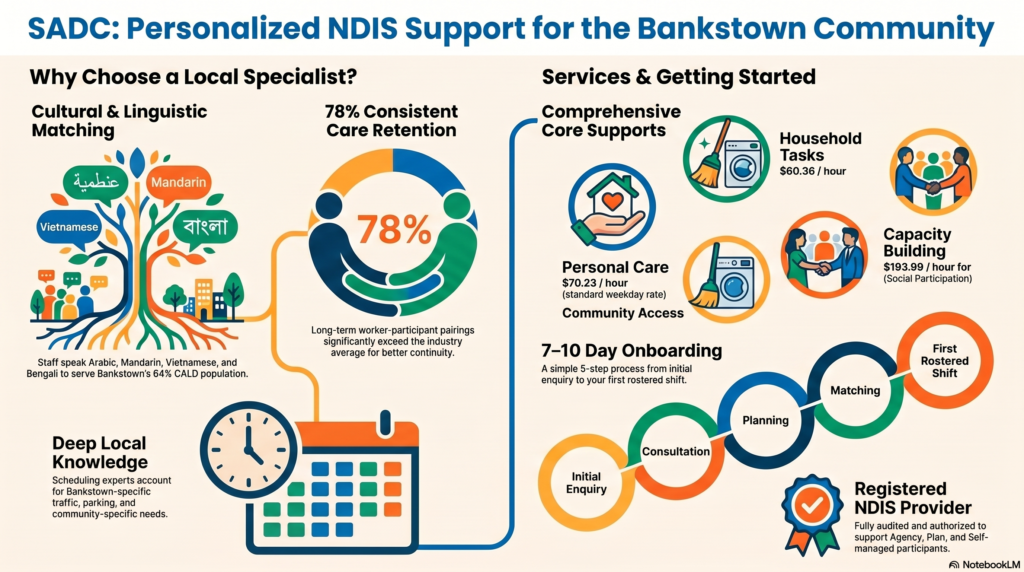
In practice, that changes how we have to work in Bankstown. Language
matching matters. A support worker who speaks Arabic, Vietnamese,
Mandarin or Greek isn’t a “nice-to-have” in this catchment. For many
participants and their families it’s the difference between feeling
understood and feeling managed. We currently have support workers fluent
in Arabic, Mandarin, Vietnamese and Bengali on our roster, and we’ll
match by request.
Cultural expectations around personal care also matter. Some families
prefer a same-gender support worker for showering and dressing. Some
prefer the support worker remove their shoes at the door. Some have
specific dietary requirements during food preparation. None of this is
unusual. It’s the baseline of doing the work properly. We ask these
questions during the initial assessment, not the third visit.
And then there’s just knowing the actual area. Bankstown isn’t a
single neighbourhood. Yagoona is different from Padstow which is
different from Punchbowl which is different from Chullora. Our
scheduling team knows the route times, the difficult turns, the streets
where parking is hostile, and the Westfield car park entrances that get
jammed at school pickup. This sounds trivial but a support worker stuck
in traffic for 25 extra minutes is 25 minutes of support that didn’t
happen.
What This Costs You
If you’re plan-managed or NDIA-managed, you don’t pay anything
directly. We invoice the NDIS Price Guide rates against your approved
budget. Current 2025–26 NDIS price caps for the most common Bankstown
supports are:
| Support type | Weekday standard rate |
|---|---|
| Assistance with self-care (1 worker, weekday daytime) | $70.23 / hour |
| Assistance with household tasks | $60.36 / hour |
| Community access (1:1, weekday) | $70.23 / hour |
| Capacity building — increased social participation | $193.99 / hour |
Saturday, Sunday, evening, and overnight rates are higher per the
official NDIS Pricing Arrangements. We charge the published price guide
rate — we can’t legally charge above it for registered services, and we
don’t apply hidden surcharges.
If you’re self-managed, the rates are negotiable in principle, though
we generally hold to the price guide for consistency. If a price guide
rate genuinely doesn’t fit your situation, talk to us — we’d rather have
an honest conversation than lose you to a provider who quotes lower and
then quietly reduces hours.
A Real Example
Participant: 38-year-old woman with a spinal cord
injury from a 2021 car accident Suburb: Yagoona
Plan: $94,000 annual core supports, plan-managed
Hours requested: 18 hours per week assistance with
daily life + 6 hours community access Languages spoken at
home: Arabic and English Specific request:
Female support worker, Arabic-speaking preferred for two of the four
weekly shifts
What we did: We had two suitable workers on the
roster — one Arabic-speaking, one English-speaking with prior spinal
cord injury experience. The Arabic-speaking worker covered Tuesday and
Friday morning shifts (showering, breakfast, medication, dressing). The
other worker covered Wednesday and Saturday afternoon community access
shifts. The participant got the same two workers every week for the past
18 months.
What changed for the participant: She moved from her
parents’ home into a modified ground-floor unit at the 14-month mark.
Her mum told us during a review that she’d “gained a daughter back”
because she wasn’t carrying the entire weight of personal care
anymore.
That’s the work. Show up, same time, same way, week after week, until
the participant has the life they want. There’s no graduation
ceremony.
How We Compare to Bigger
Providers
We’re not the cheapest provider in Bankstown. We’re not the biggest.
We support around 95 active participants across south-west Sydney. We
stay mid-sized on purpose. Every participant should know their roster
manager by name, and every roster manager should know every participant.
Once a provider passes about 250 participants that breaks down. Calls go
to a queue, schedules get reshuffled by an algorithm, and the
relationship that makes the work actually work disappears.
The trade-off is that we don’t have 24-hour phone coverage.
After-hours, our on-call roster covers genuine emergencies only. If you
need a provider with a full call centre we’re not the right fit, and
we’ll tell you that on the first call.
Getting Started
If you’re considering SADC for NDIS supports in Bankstown, the
process looks like this:
- Initial enquiry — call our Riverwood office or use
the contact form on this site. Mention you’re in Bankstown and what
supports you’re looking for. - Pre-assessment chat — about 30 minutes. We talk
through your plan, what’s funded, what you actually need, and whether
we’re the right fit. - Service agreement — if we’re a fit, we draft a
service agreement based on your plan budget and the supports you’ve
requested. You can take it away and review it for as long as you
need. - Initial visit — you meet your primary support
worker in your home, before any rostered shifts. If the chemistry isn’t
right, we swap. - Rostered support begins — usually within 7–10
business days of the signed service agreement, depending on worker
availability.
There’s no obligation at steps 1–3. If you decide we’re not the right
provider, you take your plan elsewhere with no fee and no awkward
follow-up.
FAQ
Are you a registered NDIS
provider?
Yes. We’re registered with the NDIS Quality and Safeguards
Commission. Our registration covers daily life supports, household
tasks, community participation, and supported independent living.
Can I use SADC if I’m
self-managed?
Yes. Self-managed participants can use any provider. The same rates
apply.
How quickly can you start
support?
Typically 7–10 business days from the signed service agreement,
depending on worker availability and the day/time of the requested
shifts. Tuesday and Thursday mornings are our most-booked slots;
weekends generally have shorter wait times.
Do you
support participants outside business hours?
Yes — evenings, weekends, and overnight. Public holiday and overnight
rates apply per the NDIS Price Guide.
Can I request a
specific support worker?
Yes, and we encourage it. Continuity matters more than almost
anything else in disability support. Our retention rate of long-term
worker-participant pairings sits at around 78% over 12 months, well
above industry average.
What suburbs near
Bankstown do you cover?
Yagoona, Padstow, Punchbowl, Chullora, Greenacre, Condell Park,
Birrong, Sefton, Mount Lewis, and Bankstown CBD. We also cover the
broader Canterbury-Bankstown LGA from our Riverwood head office.
What if I’m not
happy with my support worker?
You can request a change at any time. We don’t penalise switches. The
fit between worker and participant is more important than scheduling
convenience for us.
This page reflects SADC’s current service offering as of April
2026. NDIS price information is sourced from the NDIA’s published
2025–26 Pricing Arrangements; refer to the NDIA website for the
authoritative version. Service availability is subject to capacity at
the time of enquiry.