A mum called us last week. Her daughter had been on the NDIS for
three years. Plan included “respite” but the mum had no idea how much
that actually translated to in real hours. She’d asked her plan manager.
The plan manager said something about “Core Supports flexibility” and
“MMM 1 pricing.” Mum got off the call more confused than before.
She isn’t alone. The NDIS price guide is honest about respite funding
but it’s not written for parents. The terminology (“Short Term
Accommodation,” “Medium Term Accommodation,” “Improved Daily Living,”
“Core supports flexible budget”) makes it sound like there are five
different respite budgets when really there’s one or two depending on
your plan setup, with rates that change based on staffing ratio, time of
day, and whether the support is in-home or in a respite facility.
This guide is the version we wish someone had given that mum two
years ago. It’s about translating NDIS plan budgets into real respite
hours, in 2026, for a typical Sydney participant. We’re SADC, a
registered NDIS provider in Riverwood supporting participants and their
families across Sydney. We’ve delivered respite shifts to about 60
participants in the last 12 months.
What Counts as Respite
Under the NDIS?
In the NDIS world, “respite” isn’t actually a single line item
anymore. Since the 2020 reforms, respite is delivered through a few
different support categories depending on the form it takes:
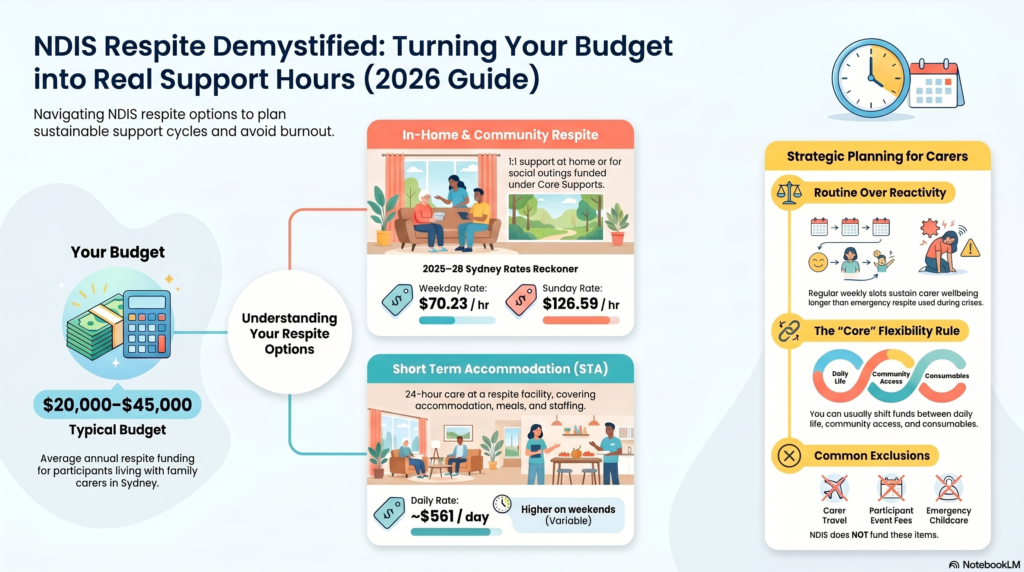
1. In-home respite. A support worker comes to the
participant’s home for a few hours so the primary carer can leave.
Funded under Core Supports, Assistance with Daily Life
at the standard hourly rates.
2. Community respite. A support worker takes the
participant out, for an activity, social outing, sport, or just a walk, for a defined period so the carer gets a break at home. Funded under
Core Supports, Assistance with Social and Community
Participation.
3. Short Term Accommodation (STA). The participant
stays at an approved respite house or facility for a few nights, with
care included. Includes accommodation, food, support staff, and any
approved activities. Funded under its own category: Core
Supports, Short Term Accommodation.
4. Medium Term Accommodation (MTA). Longer-stay
temporary housing, typically when the participant is between living
situations. Less common as standard respite but appears in some
plans.
The category your plan uses shapes how flexibly you can move funds
around. Core Supports is generally flexible across the four
sub-categories (Daily Life, Social/Community, Consumables, Transport).
If your plan was approved with “Core Supports flexible budget,” you can
shift dollars between in-home respite, community respite, and short-term
respite as needs change.
How Much
Funding Goes Into Respite (Typical 2026 Plans)
Plans vary enormously depending on the participant’s needs and family
situation. But for a sense of what’s typical, here are the patterns we
see across our Sydney participants:
Participant living with family, primary carer is a parent or
partner: – Most plans include 4–10 hours per week of in-home or
community respite under Core Supports – Many also include 14–28 nights
per year of Short Term Accommodation – Total respite-related budget:
roughly $20,000–$45,000 per year (within Core Supports)
Participant in supported independent living (SIL) with
rotating shifts: – Less standalone respite because shift
workers ARE the support – May include 7–14 nights per year of STA for
variety/holidays
Participant living independently with informal carer
support: – Typically lower respite allocation, 2–6 hours per
week of in-home support – Often paired with Plan Management or Support
Coordination so the carer-participant pair can review what’s working
The actual hours you can buy with that funding depends on the rate.
Here’s the 2025–26 reckoner.
Translating Plan
Dollars Into Real Hours
The NDIS Pricing Arrangements 2025–26 set the rates. For Sydney
(which is in NSW Major Cities: MMM 1 pricing zone), the standard caps
are:
| Support type | Weekday day rate | Saturday | Sunday | Public holiday |
|---|---|---|---|---|
| Assistance with self-care (1:1, daytime) | $70.23/hr | $98.41/hr | $126.59/hr | $154.78/hr |
| Assistance with household tasks | $60.36/hr | |||
| Assistance with community participation | $70.23/hr | $98.41/hr | $126.59/hr | $154.78/hr |
| Short Term Accommodation (1:1, weekday, 24-hour care) | ~$561/day | |||
| Short Term Accommodation (1:2, weekday, 24-hour care) | ~$351/day |
Higher-intensity support (1:1 versus 1:2 staffing, or active
overnight versus sleepover) costs more per day for STA.
Practical example: if your plan has $26,000
allocated to “Assistance with Daily Life” within Core Supports and you
want to use it for 6 hours/week of in-home respite at $70.23/hour
weekday:
- Weekly cost: $421.38
- Annual cost (52 weeks): $21,911.76
- Remaining: $4,088 for additional one-off or weekend shifts (where
rates are higher)
That’s a sustainable 6-hour weekly rhythm with a small buffer. If you
tried to push to 8 hours/week ($29,215.68/year), you’d be over-budget
and either need to absorb the excess somehow or reduce hours.
What’s NOT Covered
This is the most common source of family disappointment. The
following are NOT typically funded under NDIS respite:
- Carer’s holiday accommodation. If the primary carer
wants to go away, NDIS funds CAN pay for the participant’s STA stay
during that period. But they don’t fund the carer’s travel,
accommodation, or meals. - Activity costs above the support rate. STA funding
includes care; it does NOT cover the participant’s entry fees to events,
restaurants, or activities. Some providers include a small daily
activity allowance; we don’t. - Transport to and from STA. Limited transport
funding in plans, separately budgeted. - Childcare for the carer’s other children. NDIS
doesn’t cross-subsidise. - Unscheduled overnight emergency respite that
exceeds the plan’s STA allocation. The NDIS has emergency provisions but
they require advance application. - Routine hairdressing, beauty, or non-disability-related
personal services. Not respite-funded.
How to Make Your
Respite Allocation Go Further
Here’s what we tell families:
1. Plan respite around predictable carer rest needs, not
crisis points. A regular weekly 4-hour Saturday morning slot
(carer goes for a walk, has coffee, sees a friend) does more for
sustained wellbeing than 16 emergency hours after a burnout. Our
long-term retention data shows participant-carer pairs with regular
weekly respite stay supported for 2–3 years longer on average than those
who use respite reactively.
2. Mix in-home with community respite. Some weeks
the carer needs to physically leave. Some weeks the participant needs to
physically leave. Both are valid uses of respite funding. Most plans let
you flex between Daily Life and Community Participation categories.
3. Use Short Term Accommodation strategically. STA
is more expensive per hour than in-home respite, but it’s the only thing
that covers extended carer rest (think: weekend away, a planned hospital
stay for the carer, a Christmas break). Book early. Most Sydney STA
providers fill 10–14 weeks ahead during school holidays.
4. Don’t pay for unfilled shifts. If your provider
is invoicing for shifts that didn’t happen, push back. Reputable
providers don’t bill for cancellations within reason. If they do,
they’re showing you something about their billing practices.
5. Review hours every 6 months. Plans run 12–36
months but family situations change quarterly. If 4 hours of weekly
respite has become inadequate as the participant’s needs grow, raise it
at the next plan review.
A Real Example
Participant: 19-year-old with cerebral palsy,
full-time wheelchair user, lives with parents in Greenacre
Plan: $52,000 in Core Supports: Assistance with Daily
Life Family situation: Mum is the primary carer, dad
works full-time, younger sibling at school
Initial respite use: 4 hours every second Saturday
(8 hours/month). Mum used the time for her own appointments. Wasn’t
quite enough. She felt she was using respite for chores rather than
rest.
What we changed: Restructured to 6 hours weekly
(Wednesday afternoon when sibling has school activities) plus 14
nights/year of STA covering school holiday weeks. Same single primary
support worker for the weekly shifts; STA at the same approved facility
each time.
Outcome 12 months in: Mum reports the Wednesday
afternoon shift is “the difference between coping and not coping.” The
two STA weeks per year give her and her husband a chance to see family
interstate. The participant has built a positive relationship with the
STA staff and now actively looks forward to it (where previously he was
anxious about staying away from home).
This is what a deliberately-designed respite allocation does.
How to Set Up NDIS
Respite Care with SADC
If you’re an NDIS participant or family member in Sydney looking for
respite support, the process:
- Initial enquiry: call our Riverwood office or use
the contact form. Tell us your plan management type, your suburb, and
the kind of respite you’re considering (in-home, community, STA). - Pre-assessment chat: about 30 minutes. We talk
through your plan budget and the rhythm that would actually work for you
and the carer. - Service agreement: drafted based on your plan and
the support you’ve requested. - Worker meeting: you meet your primary respite
support worker before any rostered shifts. If the chemistry isn’t right,
we swap. - Rostered support begins: usually within 7–10
business days from signed agreement. STA bookings work on a longer lead
time depending on facility availability.
There’s no obligation. If we’re not the right provider, you take your
plan elsewhere. No fee, no awkward follow-up.
FAQ
How many hours
of respite does the NDIS provide?
There’s no fixed number. Each plan allocates funds based on the
participant’s needs and the carer’s situation. Typical Sydney plans we
see range from 4–10 hours/week of in-home or community respite plus
14–28 nights/year of STA.
What’s
the difference between respite and Short Term Accommodation?
Respite is the broader concept, giving the carer a break. STA is the
specific NDIS support category for overnight stays at a respite
facility.
Can I take my respite
hours all at once?
Generally yes, but it depends on what’s in your plan. Talk to your
plan manager or support coordinator about flexibility within Core
Supports.
Can I use NDIS
respite funding for a holiday?
You can use STA funding for the participant to stay somewhere with
care while the carer goes elsewhere. The NDIS does NOT pay for the
carer’s travel, accommodation, or holiday costs.
Does the NDIS cover
emergency respite?
Limited emergency provisions exist but they require advance
application or genuine crisis triggers. Most respite is planned through
your existing plan budget.
Can family members
provide paid respite?
Generally no. NDIS rules limit family being paid as support workers
in most circumstances, with narrow exceptions.
How do I
know if my plan has enough respite funding?
Add up your typical weekly hours × the relevant hourly rate × 52
weeks, plus any STA cost. Compare against the relevant Core Supports
budget allocation. If you’re 80%+ utilised, request more at the next
plan review.
What if I want to
change support workers?
You can. We don’t penalise switches. The fit between participant,
family, and worker matters more than scheduling convenience.
This guide reflects SADC’s service offering and the NDIS Pricing
Arrangements 2025–26 as of April 2026. Refer to the NDIA website for the
authoritative price guide and rules. For advice specific to your plan
and circumstances, contact us via this site or speak to your support
coordinator.